How to Photograph Jewellery on Yourself (Without a Studio)
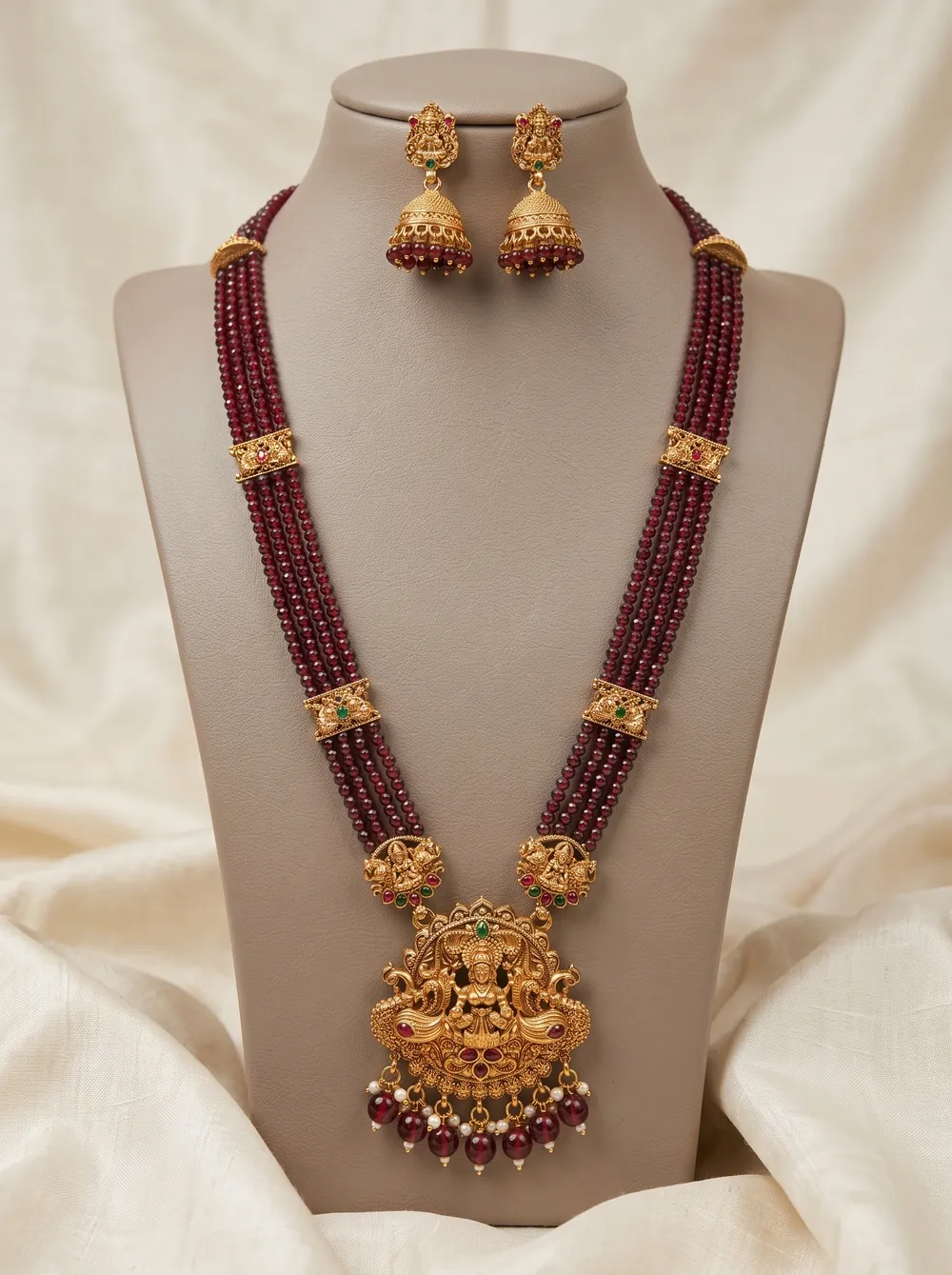
Almost everyone has had this: a set looks beautiful on, you take a photo, and the photo looks nothing like it. It is rarely the jewellery and almost never the phone. It is four fixable things, and none of them costs anything.
1. Turn the flash off and go to a window
A phone flash is a small, hard light source pointed straight at you from the same direction as the lens. On jewellery that produces a white blown-out patch exactly where the detail is, and no shadow anywhere.
Cast work needs shadow to read. Stand near a window, side-on to it, at any time of day that is not direct midday sun. That single change does more than every other tip here combined.
For polished or heavily stoned pieces the opposite problem appears: too much reflection. Step back from the window slightly or let a thin curtain soften it.
2. Stop shooting from above
The most common jewellery photo is taken at chest height pointing slightly down, which foreshortens a necklace into a shapeless curve and hides the drop entirely.
Put the camera at the same height as the piece. For a collar that is roughly collarbone height; for a haram it is nearer the middle of your chest. Have someone else take it if you can, because the angle at arm's length is never quite right.
3. Fix the background before the pose
A busy background is why a good piece looks cheap in a photo. The eye cannot separate the jewellery from the wall behind it.
- A plain wall, a curtain, a door. Anything without pattern.
- Darker than your outfit if the piece is gold-toned, so the edges have something to sit against.
- Nothing bright in the frame behind you, because the camera will expose for that and darken you.
4. Wear it against the right fabric
Jewellery photographs against the blouse, not against skin alone. A matte fabric gives a gold-toned piece something to stand out from; a fabric with heavy zari or sequins gives it something to compete with, and the piece loses.
If you are photographing a set to show someone, wear it on a plain blouse first. Photograph it on the real outfit after.
For the specific pieces
A collar or choker. Slight chin lift, camera at collarbone height, side light. The relief will show.
A long haram. Stand rather than sit, and photograph from slightly further back than feels right. A haram is about length and it needs room in the frame.
Jhumkas. Three-quarter head turn, not straight on. A jhumka is a dome and a straight-on shot flattens it into a circle. The turn shows the drop.
Chandbalis. Almost straight on, because a chandbali spreads sideways and the turn hides half of it. The opposite rule to jhumkas, for the opposite reason. Jhumka vs chandbali explains why they behave differently.
One thing not to do
Do not edit the colour afterwards. Pushing warmth to make gold-plating look richer is exactly how a photo stops matching the piece that arrives, and if you are sending the photo to someone who might buy the same thing, it sets them up for a disappointment that is not the jewellery's fault.
Pieces worth the effort
- Peacock Lakshmi crystal bead long haram - length that rewards standing back.
- Lakshmi Peacock temple necklace set - cast relief that side light brings out.
- Antique gold South Indian jhumka, scrollwork top - matte, so it photographs without flare.
If you send us a photo you are happy with, it can go on the product page. Browse temple jewellery sets or crystal necklace sets.
The honest part
Everything here is gold-plated Zamak with hand-set kemp and kundan stones, cast and finished in our workshop in Kandivali East, Mumbai. It is imitation jewellery, not solid gold, and we say so on every product page rather than leaving it to be found out. Free shipping across India, GST included in the price, and a manufacturing defect reported within 48 hours of delivery with a continuous unboxing video is repaired or replaced free.