The Mango Motif and the Manga Malai
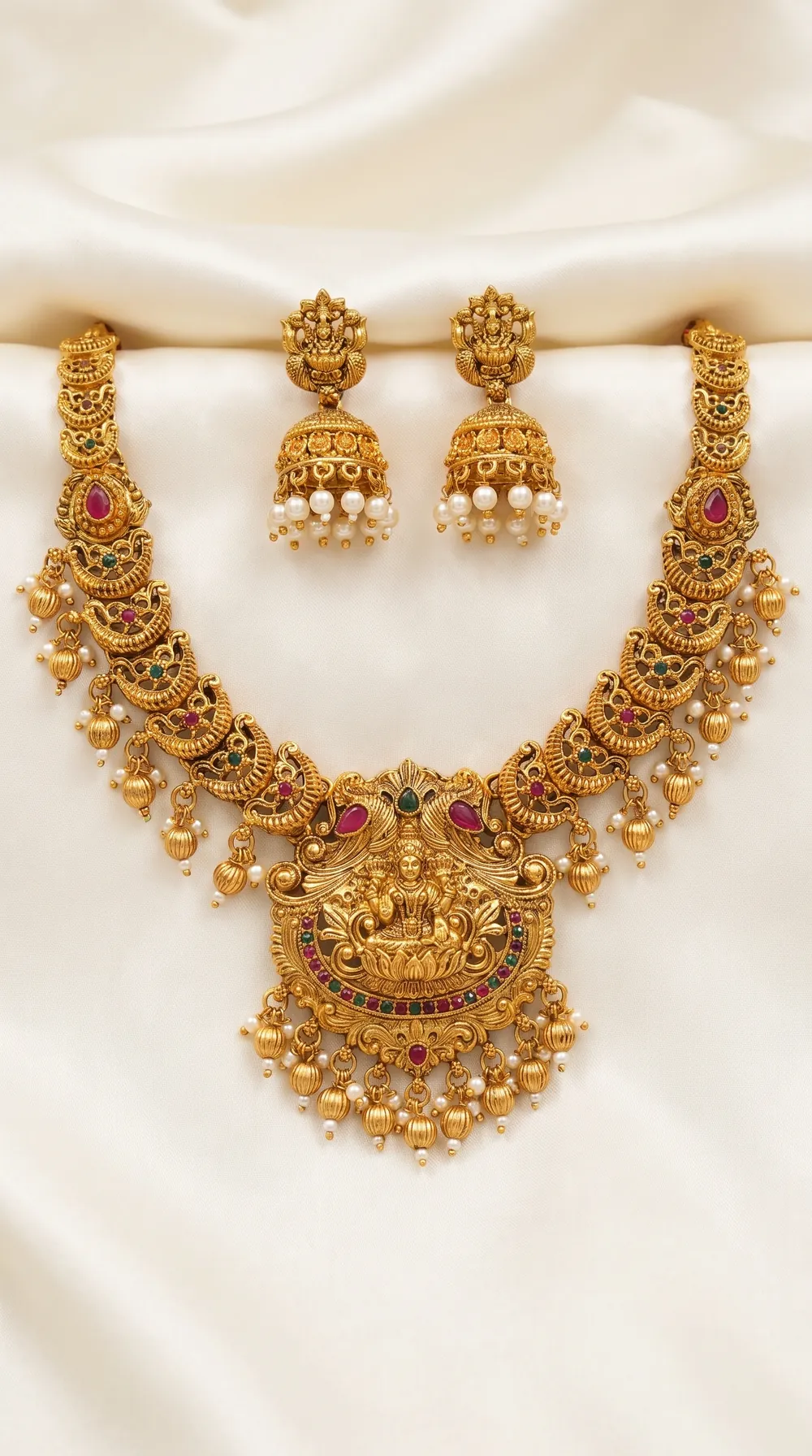
If you had to name one shape that says South Indian temple jewellery, it would not be the Lakshmi figure - it would be the mango. The repeating mango link is the oldest and most characteristic arrangement in the whole tradition.
Why a mango
The mango stands for plenty: a good harvest, a full home, children. It is the same wish the whole category carries, expressed in the shape that a South Indian household reads instantly.
The form is properly called manga in Tamil, and a necklace built from repeating mango links is a manga malai - literally a mango garland.
How a manga malai is built
The construction is conventional, and knowing it tells you whether a piece is following the tradition or borrowing its look:
- Links repeat outward from the centre, growing slightly smaller toward the ends. Uniform links all the way round is a modern simplification.
- The mango tilts. Each link sits at a slight angle, alternating, so the necklace has movement rather than reading as a flat row of identical shapes.
- The point faces outward on the classical arrangement.
- Lakshmi sits at the centre, larger than the links, with the mangoes leading the eye to her. She is the destination; the mangoes are the path.
- Kemp marks the tips - a stone at the point of each mango, or at every alternate one. Kemp is punctuation here, not a field. Kemp stones explained covers the placement rule.
Judging one
The mango is a simple outline, which makes casting quality easy to see:
- The outline should be crisp along its whole curve. A worn mould rounds the point first, so a mango with a soft tip came from a tired mould.
- Internal detail - most mango links carry a pattern inside the outline. That detail is the first thing to fill in.
- The junction between links should be a clean joint, not a merged lump.
- Compare the end links to the centre ones. Ends are finished last.
Where else the mango appears
Once you see it you will find it everywhere in South Indian work: on jhumka tops, as the drop on a haram, along a vaddanam waist belt, as the shape of a nethi chutti. It is the tradition's default ornamental unit the way the paisley is in textiles - and the two shapes are relatives.
Short or long
The manga malai exists at both lengths and they do different jobs:
As a collar it sits at the collarbone, the mangoes framing the throat. This is the most versatile bridal piece there is and the one to buy first.
As a haram it falls below the bust, usually with larger links and more space between them.
Traditionally a bride wears both, layered. They are sold separately here so you can decide - the necklace length guide covers layering.
Shop this look
- Lakshmi Mango Temple Necklace Set with Jhumkas - the mango-link collar, with matching jhumkas.
- Lakshmi Kemp Stone temple necklace set - kemp used the traditional way.
- Peacock Lakshmi crystal bead long haram - the long layer.
More in why Lakshmi sits at the centre, the peacock motif, and the temple jewellery sets edit.
The honest part
Everything here is gold-plated Zamak with hand-set kemp and kundan stones, cast and finished in our workshop in Kandivali East, Mumbai. It is imitation jewellery, not solid gold, and the product page says so. Free shipping across India, GST in the price, and a manufacturing defect reported within 48 hours of delivery with a continuous unboxing video is repaired or replaced free.