The Peacock in Indian Jewellery, and How to Read It
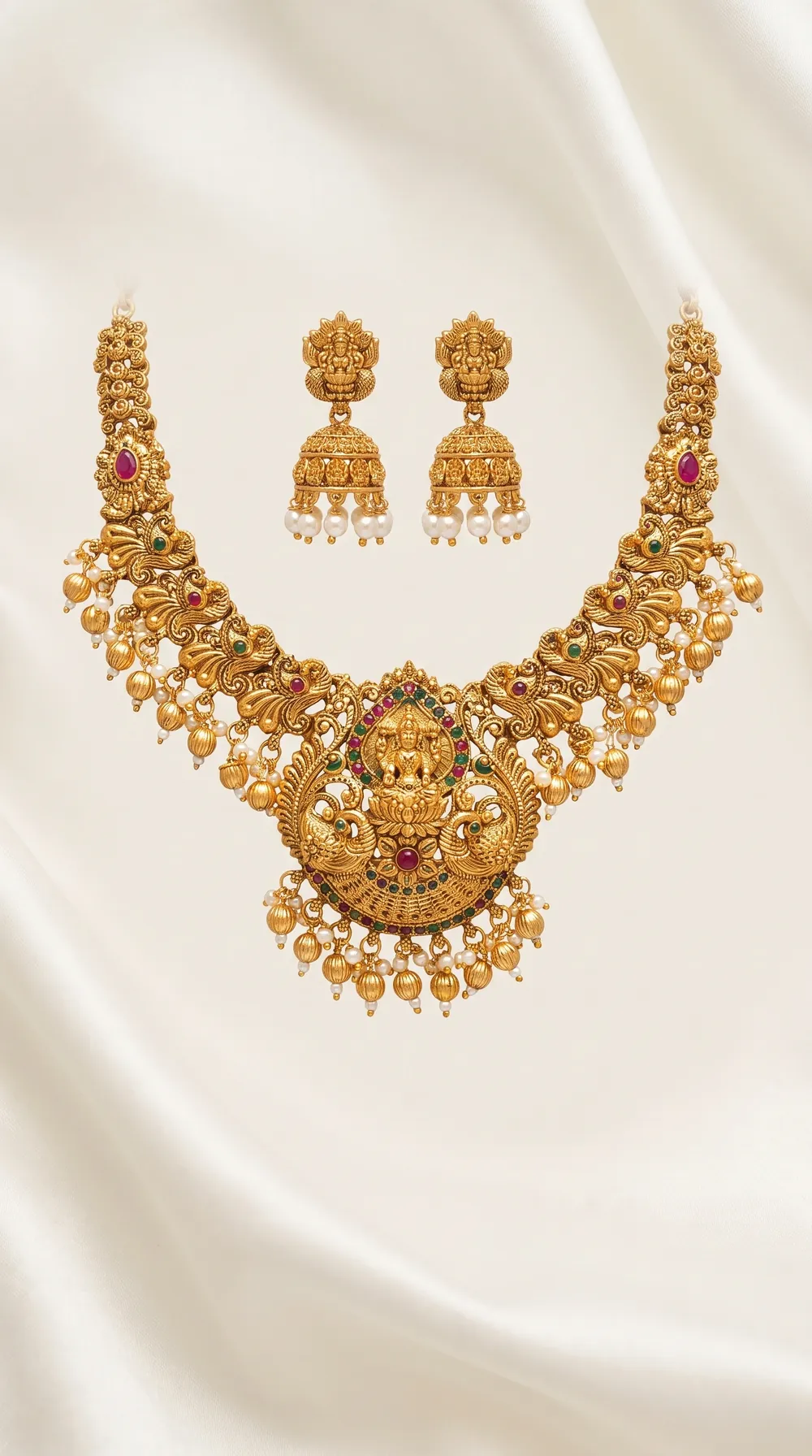
After Lakshmi, the peacock is the motif you will see most often on South Indian temple jewellery. It is also the motif where casting quality is easiest to judge, because a peacock has a lot of small parts that either survive the mould or do not.
What it means
The peacock is associated with the monsoon - it displays before the rains - and by extension with abundance, renewal and beauty. In temple work it carries the same wish as the mango: that what is coming will be plentiful.
It is also a god's mount. The peacock carries Kartikeya, and on Tamil and Andhra work it turns up in that role as often as it does as ornament.
How peacocks are arranged
Almost never alone, and almost never at the centre. The arrangement is conventional and it is worth knowing because it is a quick authenticity check:
- Paired, facing each other, flanking a central Lakshmi. The peacocks frame; they do not replace her.
- Facing inward, not outward. A pair facing away from the centre is a design that has copied the shape without the grammar.
- Tail feathers sweeping toward the centre, filling the space between the bird and the pendant.
On a haram, peacocks often appear at the pendant rather than along the chain, because the pendant is where there is room for the tail.
Judging the casting
A peacock has a crest, a beak, an eye, a body, and a tail with individual feathers. That is five places a worn mould shows:
- The crest - three small feathers on the head. These vanish first. On a poor casting the head is a smooth curve.
- The eye - should be a distinct dot, not a dimple.
- The gap between beak and body. A crisp casting leaves daylight there. A tired mould fills it in.
- Tail feathers - individually defined, with visible separation. A blurred tail is the single most common sign of a worn mould.
- The line where tail meets body should be a clean junction, not a smear.
Apply those to a product photograph before you buy anything, ours included. It costs nothing and it tells you more than any description does.
Peacock, parrot, swan
Three birds appear on this kind of work and they are not interchangeable:
Peacock - long sweeping tail, crest on the head, usually paired.
Parrot (kili) - short, rounded, curved beak, often shown with a fruit. Associated with love and messages; common on Tamil work.
Swan (hamsa) - long neck, no crest, no display tail. Associated with discernment.
If a listing says peacock and the bird has a short round tail and a hooked beak, it is a parrot, and whoever wrote the listing was not looking.
Why the finish matters here
All of that detail is relief, and relief needs a shadow to read. This is the strongest argument for an antique matte finish over a high polish on peacock work - polish fills the shadow with reflected light and a well-cast tail reads as a bright smear. What antique gold finish means explains the mechanism.
Shop this look
- Lakshmi Peacock temple necklace set - paired peacocks flanking the centre, the classical arrangement.
- Peacock Lakshmi crystal bead long haram - peacock at the pendant, where the tail has room.
- Floral Peacock Lakshmi temple choker.
- Antique gold South Indian jhumka, peacock top.
More in why Lakshmi sits at the centre, kemp stones explained, and the temple jewellery sets edit.
The honest part
Everything here is gold-plated Zamak with hand-set kemp and kundan stones, cast and finished in our workshop in Kandivali East, Mumbai. It is imitation jewellery, not solid gold, and the product page says so rather than leaving it to be found out. Free shipping across India, GST in the price, and a manufacturing defect reported within 48 hours of delivery with a continuous unboxing video is repaired or replaced free.