Temple vs Kundan Jewellery: Which One Suits Your Wedding
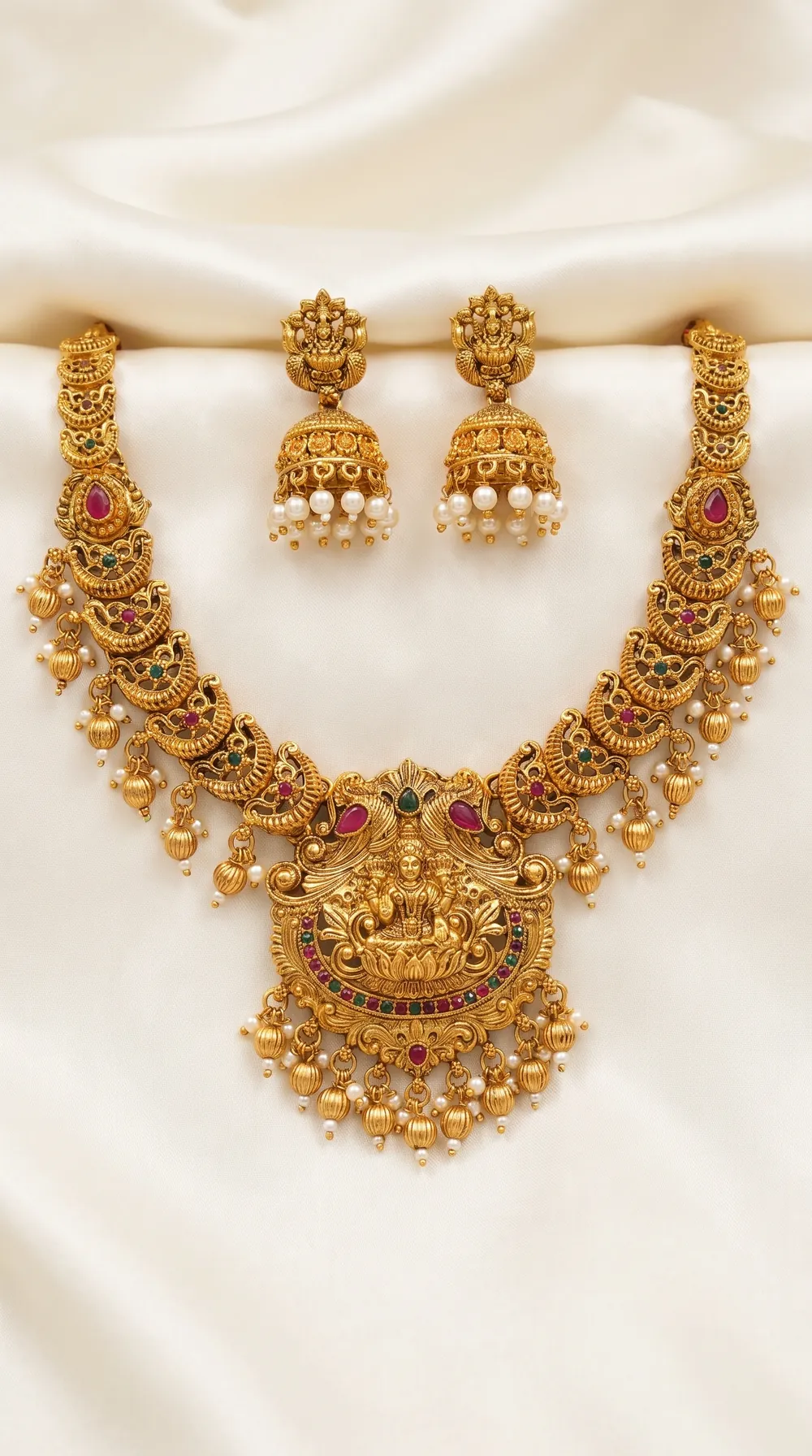
Most brides are choosing between these two without anyone having explained what actually separates them. Both are gold-toned, both turn up at every Indian wedding, and both get called "traditional" in product listings. They are not variations of one idea. They come from different traditions, they are made by different processes, and they behave completely differently in photographs.
The difference is how the piece is made
Temple jewellery is cast. The gold work is the subject: a Lakshmi figure at the centre, mango or peacock motifs repeating outward, and relief deep enough to hold a shadow. Stones appear as punctuation around the motifs, usually kemp, the deep ruby-red temple stone traditionally set against green. Take the stones off a temple piece and you still have a piece.
Kundan is set. The gold-toned frame exists to hold flat, foiled stones in place, and the stones are the subject. The metalwork is a setting rather than a sculpture. Take the stones off a Kundan piece and you have an empty frame.
That single difference drives everything else.
How each one photographs
This is the part nobody mentions until the photos come back.
Temple work reads as depth. The relief catches light unevenly, so the motifs stay legible from across a room and in a photograph taken from ten feet away. It does not flare. Under a mandap, where the lighting is warm and uneven, that is a real advantage.
Kundan reads as sparkle. The foiled stones throw light back at whatever is pointing at them, which is spectacular under reception lighting and directly into a camera flash. In daylight, or under the flat warm light of a daytime ceremony, it is quieter than people expect.
If most of the photographs that matter are from a daytime ceremony, temple gives you more. If they are from the reception, Kundan does.
What each one suits
Match the jewellery to the outfit, not to your skin tone. That is the single most useful rule here, and it is the one most often got backwards.
- A lehenga or silk saree with heavy zari embroidery is already busy and already sparkling. Kundan competes with it evenly. Temple work sits against it as contrast.
- A matte, pastel or minimally worked outfit gives temple work nothing to compete with, and the cast detail becomes the thing people look at.
- A silk saree with a temple border is asking for temple jewellery. The motifs rhyme.
Can you wear both?
Yes, and it is traditional to, but not in the same register. Pick one to carry the look and let the other support it. A temple collar with Kundan jhumkas works, because the necklace is the statement and the earrings are the finish. A full Kundan necklace with heavy temple jhumkas does not, because both are asking to be looked at.
The one rule worth keeping: stay in one metal tone across the whole set. Mixed gold tones across necklace, earrings and tikka is what makes an expensive-looking set read as assembled from whatever was in the drawer.
What changes when the jewellery is imitation
Nothing about any of the above. The motifs, the proportions and the setting technique are the same. What differs is the base: Zamak with gold plating rather than solid gold, and hand-set kemp and kundan rather than mined stones. We say so on every product page rather than leaving it to be discovered.
What it does change is care. A plated piece lives or dies on the plating staying intact, which means keeping it away from perfume, sweat and a damp drawer. Our jewellery care guide is the short version. If you want to judge plating quality on any piece, including ones we did not make, real vs fake gold-plated jewellery covers how.
Shop this look
- Lakshmi Mango temple necklace set - cast temple work, kemp detail, jhumkas included.
- Polki kundan teardrop chandbali - the Kundan side, in the shape that suits most faces.
- Lakshmi Kemp Stone temple necklace set - kemp used the traditional way, as punctuation rather than a field.
Browse the full temple jewellery sets and kundan earrings edits, or read Kundan vs Polki if Kundan is the side you are deciding within.