Kundan vs Polki: what brides should actually compare
Kundan settings hold flat, foiled glass stones in gold-toned frames for a formal, structured sparkle; Polki-style pieces use uncut-look stones for a raw, older-world glow. For daytime weddings, Polki photographs softer; for receptions under artificial light, Kundan throws more fire. Match the base tone to your outfit borders, not your skin tone - that is what shows in photos.

Here is a simple way to decide: if your lehenga has zari-heavy embroidery, choose Kundan so the sparkle competes evenly with the fabric. If your outfit is matte or pastel, Polki's soft glow complements rather than overwhelms it. Either way, keep the metal tone consistent across the set - necklace, earrings, maang tikka - so the bridal look reads as one piece.
Browse our bridal sets and jhumka earrings for Kundan and Polki-inspired options, or WhatsApp us your outfit photo for a recommendation.
What is the difference between Kundan and Polki?
Kundan is a setting method: stones held in place by strips of pure gold worked around them. Polki is a stone: a diamond left uncut, showing its natural face instead of machine facets. So the two are not rivals — most polki jewellery is set using the kundan technique.
That distinction matters more than it sounds, because almost every "Kundan vs Polki" comparison treats them as two styles to choose between. They are answers to different questions. Kundan answers how is the stone held. Polki answers what is the stone. A piece can be both at once, and the grandest bridal sets usually are.
Why is Kundan called a setting and not a stone?
Because the gold does the work. The Victoria and Albert Museum describes the technique plainly: “By using pure, soft, 24-carat gold (kundan), the goldsmith can set gemstones directly into fragile enamelled surfaces, or into engraved gem materials, such as nephrite jade and rock crystal.”
Pure gold is soft enough to be pressed cold around a stone without heat, which is the whole point — it lets a goldsmith set stones into enamel or jade that would crack under a torch. It is also why kundan pieces have that flat, framed, almost architectural look: the visible gold is structural, not decoration added afterwards.
Which one suits your outfit?
The deciding factor is your fabric, not your jewellery. Zari-heavy embroidery throws light in every direction, and a soft, diffuse polki glow disappears against it. Flat kundan stones hold their own because they reflect in one plane, like the zari itself. On matte silk, georgette or a pastel lehenga, the opposite is true: kundan can look hard, and polki's softer depth reads as expensive.
The light in the room decides the rest. Daytime and outdoor mandaps favour polki — uncut faces catch diffuse daylight and glow rather than flash. Evening receptions under warm spotlights favour kundan, because flat foiled stones return a direct beam cleanly while an uncut face scatters it.
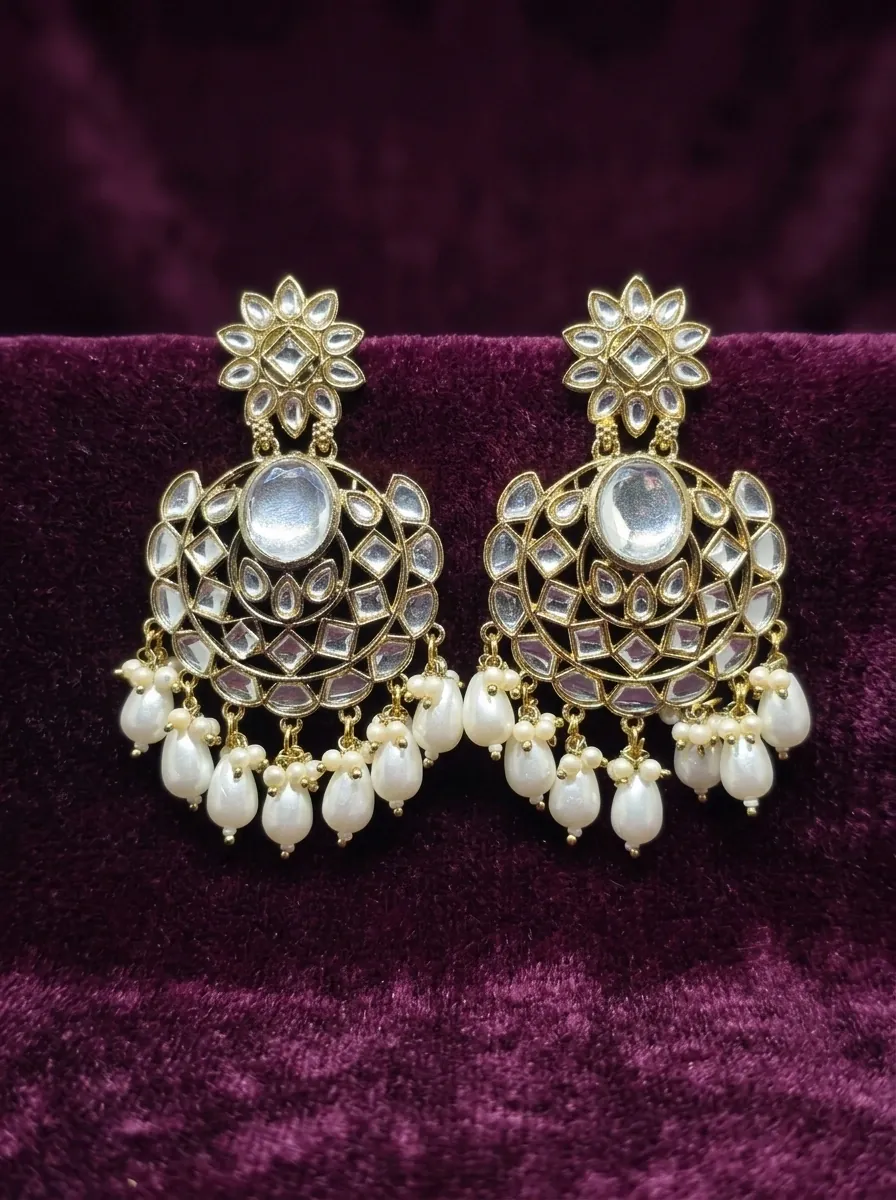
How do you tell them apart on a real piece?
Look at the edge of the stone, not the middle. A kundan stone sits flat and flush, with a thin, even gold line running unbroken around it. A polki stone sits slightly proud, and the gold line around it is uneven because the stone's own outline is irregular — it was never cut to a template.
The second tell is the back. Traditional kundan and polki are both foil-backed and closed at the rear, so no light passes through. If you can see daylight through a stone from behind, it is an open-set piece in a modern style, whichever name the label uses.
What changes when the jewellery is imitation?
Honesty first: our pieces are gold-plated brass and alloy, not 24-carat gold, and the stones are glass and crystal rather than diamond. So “kundan” and “polki” on an imitation piece describe a look, and any seller telling you otherwise is selling you something else.
What does carry across is the optics, and that is what you are actually buying. A kundan-style stone in an imitation set is flat and foiled, framed in a plated bezel, and behaves under light exactly like the original — which is why it photographs so well. A polki-style stone is given a cloudier, uncut-looking surface so it glows instead of flashing.
What does not carry across is longevity of the setting. Real kundan is held by soft pure gold that can be re-pressed by a goldsmith for generations. Plated settings are rigid; if a stone loosens it needs re-glueing, not re-setting. It is one reason we cast our bezels deeper than the trade standard — a deeper wall means the stone is held by the frame rather than by adhesive alone.
The short answer
If your outfit is heavily worked and the event is at night, take kundan. If your outfit is soft or pale and the event is in daylight, take polki. If someone offers you “kundan polki” and it looks right in both, they are not confused — that is the traditional combination, and it has been since the Mughal court.
Browse our kundan jhumka earrings and bridal sets for kundan and polki-inspired options, or WhatsApp us your outfit photo and we will tell you which way the light falls.
Shop this look
- polki-style teardrop chandbali earrings
- floral kundan chandbali earrings
 round kundan jhumka earrings