Nakshi Jewellery vs Temple Jewellery: What Is the Difference?
Nakshi and temple jewellery are often mentioned together, and many pieces are both. But the words describe different things. "Nakshi" refers to a technique - fine, raised, hand-worked detail - while "temple" refers to a style built on deity and temple motifs. Here is how to tell them apart and choose.
What is nakshi jewellery?
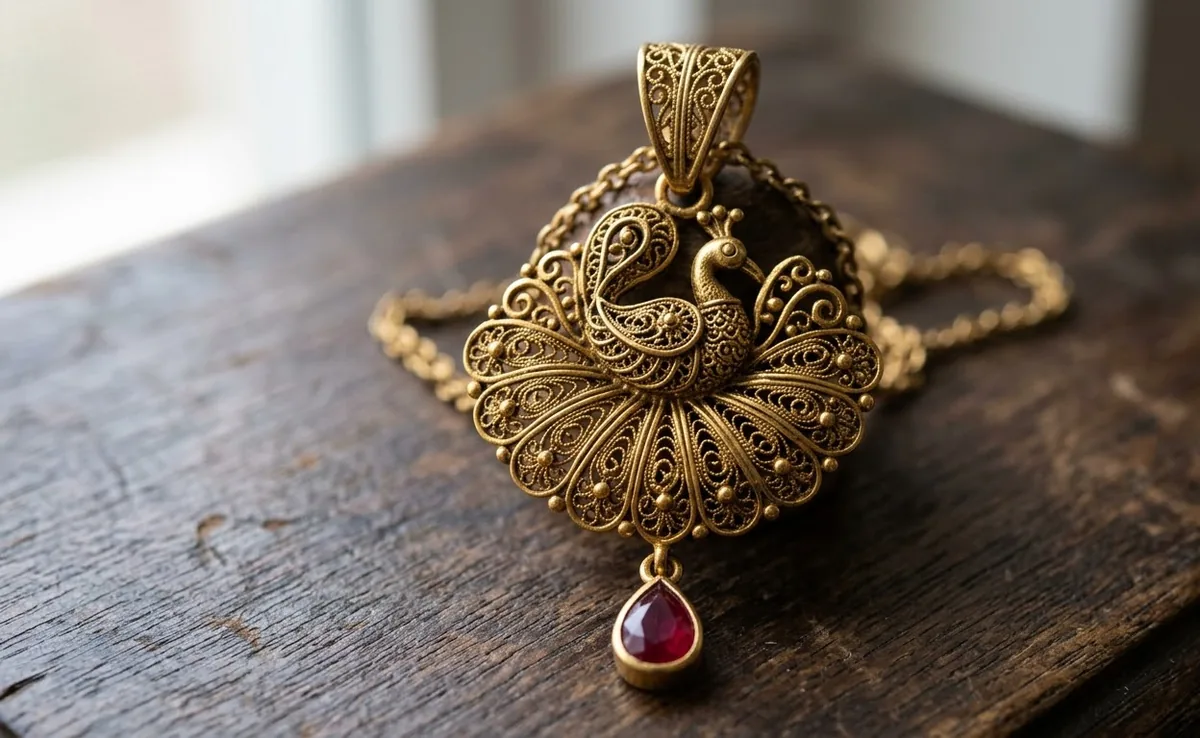
"Nakshi" (also spelled nakashi or nakas) comes from a word meaning design or engraving. Nakshi jewellery is covered in fine, three-dimensional relief work: tiny beads of metal, intricate floral and peacock patterns, and carved figures standing out from the surface. It is strongly associated with Andhra Pradesh, Telangana and Tamil Nadu, and with bridal harams and bangles.
What is temple jewellery?
Temple jewellery is a South Indian style inspired by the ornaments on deities in temples: goddess Lakshmi, peacocks, lotuses, temple towers and coins, often with kemp (ruby-red) and emerald-green stones, in an antique gold finish. Read what temple jewellery is.
Nakshi vs temple jewellery: the difference
- Nakshi = the technique of fine raised detail. It can appear on any design - floral, peacock, geometric or deity.
- Temple = the style and motifs drawn from temples and deities.
- Many pieces are both: a Lakshmi haram with nakshi work around the goddess is nakshi temple jewellery.
- Stones: temple jewellery often has kemp stones; pure nakshi pieces may have few or no stones, relying on the metalwork.
Nakshi jewellery designs
- Nakshi long haram - a long necklace covered in relief work, often with a Lakshmi or peacock pendant.
- Nakshi choker - dense raised patterns close to the neck.
- Nakshi bangles and kadas - the relief work shows beautifully on a wide bangle.
- Nakshi jhumkas - domes covered in tiny beads and floral relief.
Nakshi in gold vs gold-plated
Real gold nakshi jewellery is expensive because the fine work takes many hours and adds to making charges. Gold-plated nakshi-style pieces recreate the look through detailed casting and an antique finish. Look for sharp, deep detail in the photos - blurred relief is the first sign of a poor casting. Read spotting bad plating from a photo.
Which to choose
- For a traditional South Indian bridal look: temple jewellery with kemp stones, or a nakshi haram as the long layer.
- For a subtle, all-metal look: nakshi pieces without heavy stones.
- For festivals: a temple choker or nakshi jhumkas.
Pair a choker with a long haram for the classic bridal layering. Read choker vs long haram.
Caring for nakshi and temple pieces
The fine relief collects dust. Use a soft, dry brush to clean the recesses, and never polish an antique finish bright. Read antique finish explained.
Nakshi long haram designs
- Lakshmi nakshi haram - the goddess at the centre with relief borders.
- Peacock nakshi haram - paired peacocks along the length.
- Mango nakshi haram - mango motifs in raised work.
- Coin nakshi haram - relief-worked coins.
Long harams sit best over a silk saree with a choker above. Read the Lakshmi haram guide.
Nakshi jewellery for weddings and festivals
For weddings, a nakshi haram with kemp-stone temple jhumkas is a classic Telugu and Tamil bridal combination. For festivals like Varalakshmi Vratham, Diwali and Pongal, a nakshi choker or nakshi jhumkas alone look traditional without being bridal.
How to spot good nakshi work
- Depth: the relief should stand clearly above the surface.
- Crisp edges: petals, feathers and beads should be distinct, not blurred.
- Even finish: the antique darkening should sit evenly in the recesses.
- Finished back: the reverse should be smooth and plated.
These are the same checks that separate good gold-plated pieces from poor ones. When in doubt, ask the seller for a close-up of the detail and the back.
Frequently asked questions
What does nakshi mean in jewellery?
Fine, raised, hand-worked relief detail on the metal surface.
Is nakshi jewellery the same as temple jewellery?
No. Nakshi is a technique; temple is a style. Many pieces combine both.
Where is nakshi jewellery from?
It is strongly associated with Andhra Pradesh, Telangana and Tamil Nadu.
Browse temple jewellery sets.