South Indian vs North Indian Bridal Jewellery
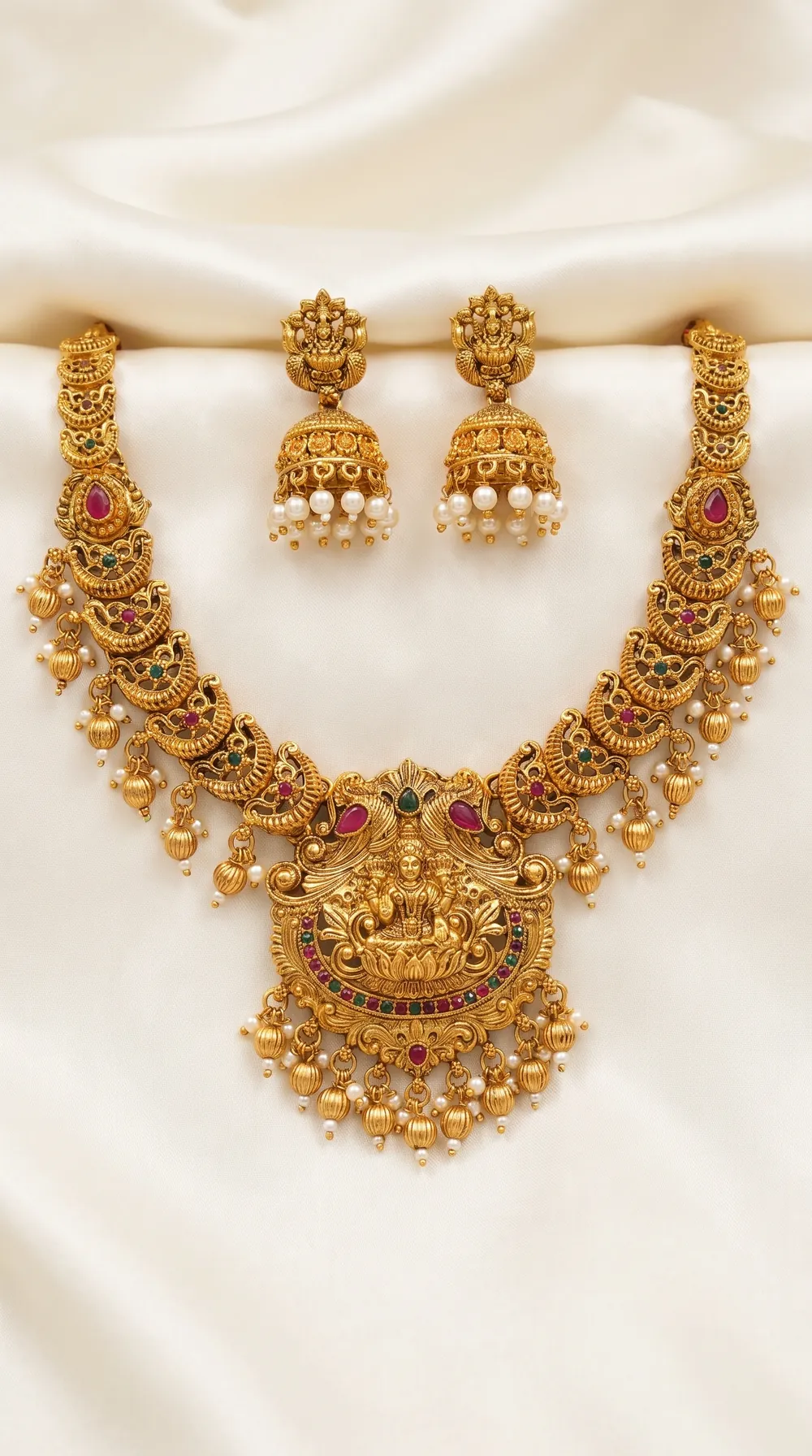
Search "Indian bridal jewellery" and you get two quite different traditions mixed together as if they were regional variations of one thing. They are separate systems with separate logic, and a bride borrowing from both without knowing which is which usually ends up looking assembled.
The short version
South Indian bridal work is cast. The gold is the subject: Lakshmi at the centre, mango and peacock motifs repeating outward, kemp stones as punctuation. Layered lengths - a short collar over a long haram - are the norm.
North Indian bridal work is set. Stones are the subject, held in gold-toned frames by the Kundan technique, often with enamel on the reverse. One statement necklace rather than layers, usually with a maang tikka carrying the same stone work.
Piece by piece
| | South | North |
|---|---|---|
| Necklace | Short temple collar, plus a long bead or crystal haram | One Kundan-set necklace, often a choker-to-collar length |
| Earrings | Jhumkas, domed, with a fringe | Chandbalis, crescent, spreading sideways |
| Forehead | Nethi chutti, worn along the parting | Maang tikka, a single drop at the parting |
| Stones | Kemp - deep red against green, as punctuation | Kundan-set, stones covering more of the surface |
| Finish | Antique matte, so cast relief reads | Brighter, so stones throw light |
The mistake people make
Wearing a South Indian temple collar with North Indian Kundan chandbalis, or the reverse. Both are beautiful; together they read as two half-sets because the finish differs. Antique matte against bright polish in the same look is the single most visible mismatch in bridal photographs, and almost nobody can say why it looks off.
If you want to borrow across traditions, borrow the shape, not the finish. A jhumka in a bright Kundan finish works with a North Indian look. A chandbali in antique gold works with a South Indian one.
At a wedding that is both
Increasingly common, and there are two honest approaches:
Split by function. South Indian pieces for the muhurtham or the daytime ceremony where cast relief photographs best; North Indian for the reception, where artificial light favours stones. Reception jewellery covers the lighting argument.
Pick one and commit. Wearing one tradition properly reads as a decision. Wearing half of each reads as neither.
What does not change
Both traditions want one metal tone across the whole set, both want the necklace and earrings to rhyme, and both suffer when two statement pieces compete. Those rules are not regional.
Shop this look
- Lakshmi Mango temple necklace set - the South Indian collar.
- Peacock Lakshmi crystal bead long haram - the layer that goes under it.
- Wide kundan chandbali earrings - the North Indian side.
More in temple vs Kundan, what Kundan jewellery actually is, and the South Indian wedding jewellery sets edit.
The honest part
Everything here is gold-plated Zamak with hand-set kemp and kundan stones, cast and finished in our workshop in Kandivali East, Mumbai. It is imitation jewellery, not solid gold, and the product page says so. Free shipping across India, GST in the price, and a manufacturing defect reported within 48 hours of delivery with a continuous unboxing video is repaired or replaced free.