Karva Chauth Jewellery: What to Wear, and What to Skip
Karva Chauth has a very specific shape - a full day of fasting, then an evening gathering, then the moment at moonrise with the chalni held up to the face. Almost every photograph from the day is taken in the last hour of it, at night, close up, with something held in front of you. That changes the calculation.
The close-up problem
The defining photograph of Karva Chauth is taken from about arm's length, through or beside a sieve, lit by a lamp. That is the closest a camera gets to your jewellery all year.
At that distance:
- Earrings matter more than the necklace, because they are in frame beside your face and the necklace often is not.
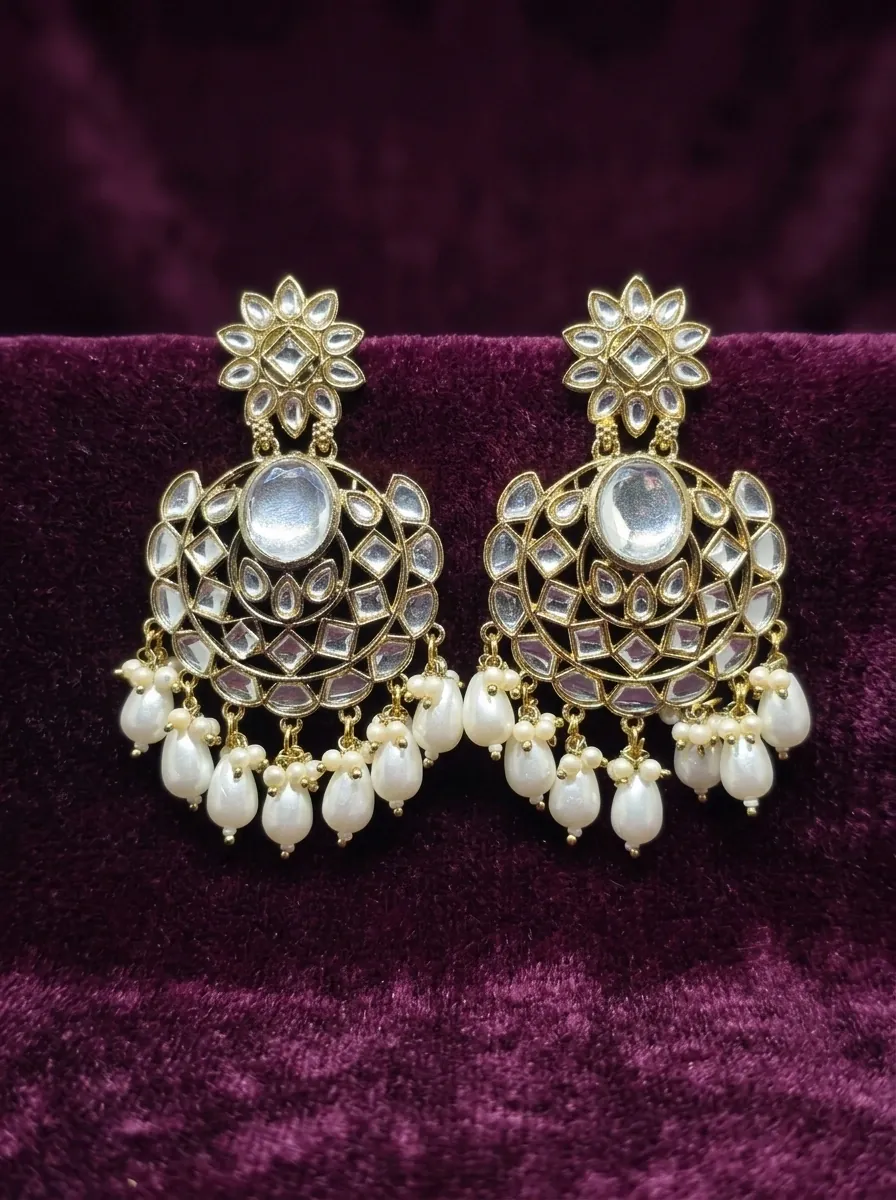
- Detail beats size. A finely worked chandbali reads beautifully at close range; a large plain piece looks large and plain.
- Anything that swings is a problem, because you will be raising and lowering your arms.
Fasting all day
A practical note that no styling guide mentions: you will have been without food or water since before sunrise. Heavy jewellery is harder to wear on an empty stomach than most people expect, and a heavy pair of earrings after twelve hours of fasting is genuinely uncomfortable.
Choose mid-weight. If you want one heavy piece, make it the necklace, which distributes across the shoulders, rather than the earrings, which hang off a piercing.
The traditional pieces
Red and gold are the colours of the day, and the pieces that belong to it are the ones a married woman wears: a mangalsutra, bangles, a maang tikka and earrings. Not all of that is jewellery you buy new each year.
What is worth buying new is the set that goes over it - a collar or chandbali that lifts a simple red saree or lehenga without competing with the pieces you already wear daily.
What to skip
- A long haram. It swings forward every time you bend to the thali and gets in the way of the arti.
- Rings on the hand holding the sieve, if they are large. They are in the frame and they catch.
- Anything you have not worn before. This is a long day in which to discover that a pair pinches.
Kemp, or kundan?
Kemp for a traditional red-and-gold look, because the stone is already that red and it sits in gold rather than fighting it. Kundan if the outfit is a lighter red or a pink, where kemp goes muddy against it.
Shop this look
- Floral kundan chandbali with pearl drops - close-range detail, mid-weight.
- Lakshmi Kemp Stone temple necklace set - kemp against gold, the traditional pairing.
- Floral Peacock Lakshmi temple choker - short, stays clear of the thali.
More in kundan chandbali earrings and temple jewellery sets. If you are deciding between earring shapes, jhumka vs chandbali goes into it properly.
Ordering in time
Dispatch is 2 to 4 business days. After that, Mumbai is 2 to 4 days, the rest of Maharashtra 3 to 5, and the rest of India 5 to 8. The honest planning number outside Maharashtra is about two weeks before the date. Shipping is free everywhere in India and the price on the card includes GST.
Everything here is gold-plated Zamak with hand-set kemp and kundan stones, cast and finished in our workshop in Kandivali East, Mumbai. It is imitation jewellery and we say so plainly - that is what puts a bridal-scale set in the hundreds rather than the lakhs.