Popular Bridal Jewellery Styles for Indian Weddings Right Now
The bridal jewellery styles Indian brides choose most today are temple jewellery, Kundan-style, Polki-style, American diamond (cubic zirconia) and antique gold-plated sets - worn in a layered way that pairs a short choker with a long haram. Which one suits you depends on your region's traditions, your outfit and how many events the wedding runs to.
This guide is about styles. For the individual pieces - maang tikka, nath, bajuband, kamarbandh and the rest - see our complete Indian bridal jewellery guide, and for what to wear at each function, the bridal jewellery checklist.
In this article (10)
- Temple jewellery: the South Indian bridal classic
- Kundan-style: the North Indian bridal favourite
- Polki-style: the uncut look
- American diamond (CZ): the bright, modern choice
- Antique gold-plated sets: the look that works for every event
- Layering: choker and long haram together
- Chandbalis and jhumkas: the earrings brides choose
- Regional bridal styles
- How do you choose a bridal jewellery style?
- Frequently asked questions
Temple jewellery: the South Indian bridal classic
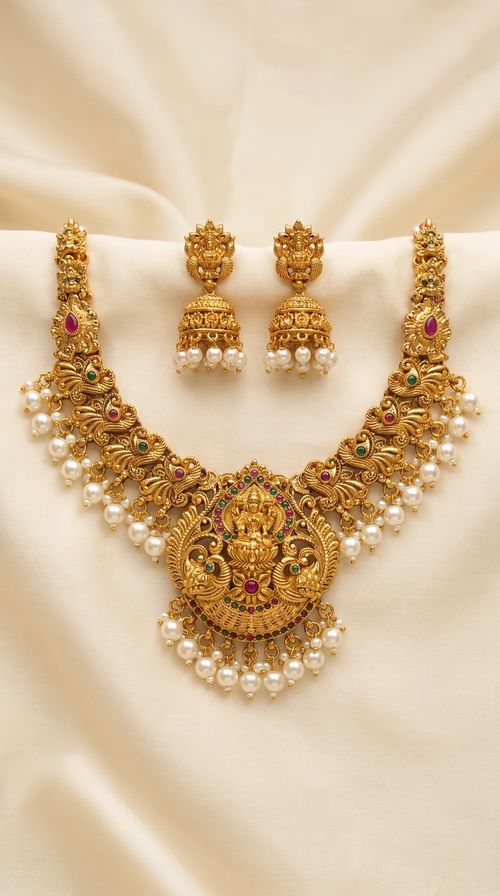
Temple jewellery is carved with Lakshmi, peacocks, lotuses and mango motifs in an antique gold finish, usually with red kemp stones and pearl or bead drops. It is the standard bridal style across Tamil Nadu, Kerala, Karnataka, Andhra Pradesh and Telangana, and brides elsewhere increasingly choose it for a silk-saree ceremony or a reception.
A full temple bridal look layers a choker, a long haram, jhumkas, a vanki on the arm and an oddiyanam at the waist. It pairs best with Kanjeevaram silk. Read what temple jewellery is and why it is so popular for the background.
Kundan-style: the North Indian bridal favourite
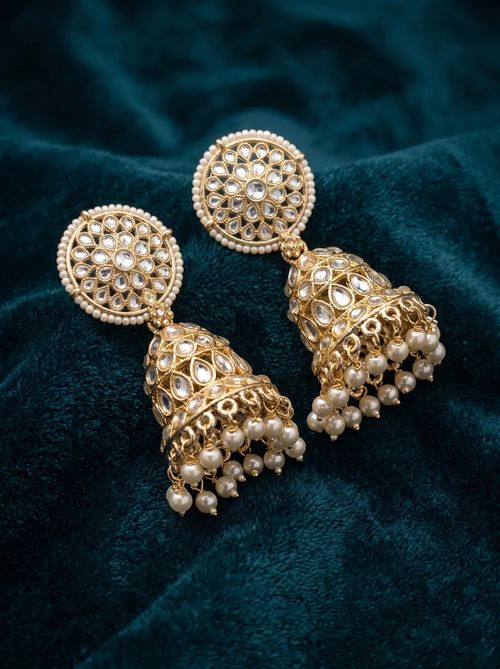
Kundan is a technique from Rajasthan and the Mughal courts: stones set into a gold foil frame, often with enamel (meenakari) on the back. It gives a flat, glowing surface of stones rather than carved metal. It is the default bridal style for many North Indian and Punjabi weddings and pairs naturally with a lehenga.
Kundan-style jhumkas and chandbalis are an easy way to bring the look into a temple or antique set without committing to a full Kundan necklace. If you are deciding between the two traditions, read temple vs Kundan jewellery and South Indian vs North Indian bridal jewellery.
Polki-style: the uncut look
Polki traditionally means uncut natural diamonds set in gold. In imitation jewellery, Polki-style pieces recreate the soft, uneven sparkle of uncut stones. It is a favourite for brides who want something that looks old and precious rather than bright, and it works for both lehengas and silk sarees. Anything sold at imitation prices is Polki-style, not Polki.
American diamond (CZ): the bright, modern choice
American diamond is the everyday name for cubic zirconia - clear, faceted stones that sparkle like diamonds. It suits cocktail nights, receptions and brides who prefer silver-tone or rose-gold looks with pastel lehengas. It photographs very brightly, which is why many brides save it for an evening event rather than the main ceremony.
Antique gold-plated sets: the look that works for every event
Antique gold-plated jewellery has a warm, slightly matte finish that looks like heirloom gold. It is the most versatile of all these styles: it sits with sarees and lehengas, with bright and muted colours, and it does not look out of place at a mehendi or a reception. Temple jewellery is usually antique gold-plated; so are many long harams and Rani Haar sets.
Layering: choker and long haram together
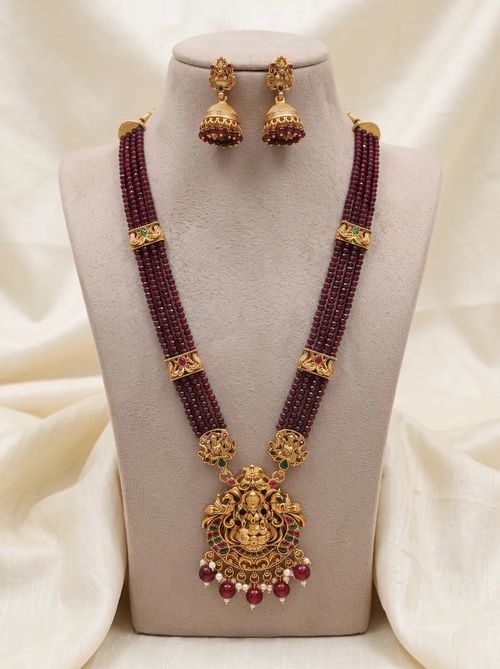
The single strongest bridal trend across styles is layering. A short choker sits at the base of the neck, and a long haram or Rani Haar falls below it towards the waist. The two sit at different heights, so they frame each other instead of competing. It is traditional in South Indian bridal jewellery and has spread to Kundan and antique looks too.
If you layer, keep the metal finish the same and let only one piece carry colour.
Chandbalis and jhumkas: the earrings brides choose
Jhumkas - the bell-shaped earring - are the classic partner for temple and antique sets. Chandbalis, crescent-moon earrings from the Kundan tradition, frame the face and suit lehengas and open hairstyles. Many brides wear jhumkas for the ceremony and switch to chandbalis for the reception.
Regional bridal styles
- Maharashtrian brides wear the nath (nose ring), thushi choker and green glass bangles - see our Maharashtrian jewellery guide.
- Bengali brides traditionally wear the shakha-pola bangles, a long necklace and the tikli - see the Bengali bride's jewellery guide.
- Punjabi brides wear the chooda and kaleere with Kundan-style sets - see Punjabi wedding jewellery.
- South Indian brides wear temple jewellery with Kanjeevaram silk - see South Indian temple jewellery.
How do you choose a bridal jewellery style?
1. Start with the outfit. A silk saree leans temple or antique; a lehenga leans Kundan-style, Polki-style or American diamond.
2. Count the events. A multi-day wedding needs more than one look. Many brides pick temple or antique for the ceremony and a lighter style for the mehendi, sangeet and reception. Our bridal jewellery budget guide shows how to split the spend.
3. Pick one star piece per look. A heavy necklace with statement earrings is plenty; add a maang tikka only if the neckline is simple.
4. Keep one finish per look. Antique gold-plated with antique gold-plated; bright gold with bright gold.
Frequently asked questions
Which bridal jewellery style is most popular in India?
It depends on the region: temple jewellery leads in South India, Kundan-style in the North and West, and antique gold-plated sets are worn everywhere because they suit both sarees and lehengas.
Can I wear imitation jewellery as a bride?
Yes. Many brides now choose imitation or gold-plated sets, especially for the events around the main ceremony, and keep family gold for the pheras or the muhurtham. Our pieces are a Zamak base, antique gold-plated, with hand-set stones - sold as imitation jewellery.
How early should I buy bridal jewellery?
Once the outfits are final, so you can match colours and necklines. Ready-stock pieces ship within 2-4 business days, but leave time to try everything on with the outfit.
Browse the South Indian wedding jewellery sets, crystal bead long harams and Kundan chandbali earrings in stock today.